AML Panel Kit

AML Panel Kit

The TRUPCR® AML Panel Kit is intended for the qualitative detection of diagnostic and prognostic markers of acute myelogenous leukaemia (AML) in peripheral blood samples on conventional and Real-time PCR technologies. Acute myeloid leukaemia (AML) is a group of haematological diseases, phenotypic and genetically heterogeneous, characterized by clonal expansion of myeloid precursors with diminished capacity for differentiation. AML represents 15 to 20% of acute leukaemia cases in children and 80% in adults. Myelogenous leukaemia is present when myeloid cell lineages such as granulocytes or monocytes are affected.

    • TRUPCR® AML Panel Kit is a combination of conventional PCR and Real-time PCR.
    • TRUPCR® AML Panel Kit is a comprehensive kit which includes complete cDNA chemistry for RNA-based transcripts.

Key Features of the AML Panel Kit:

    • CE-IVD
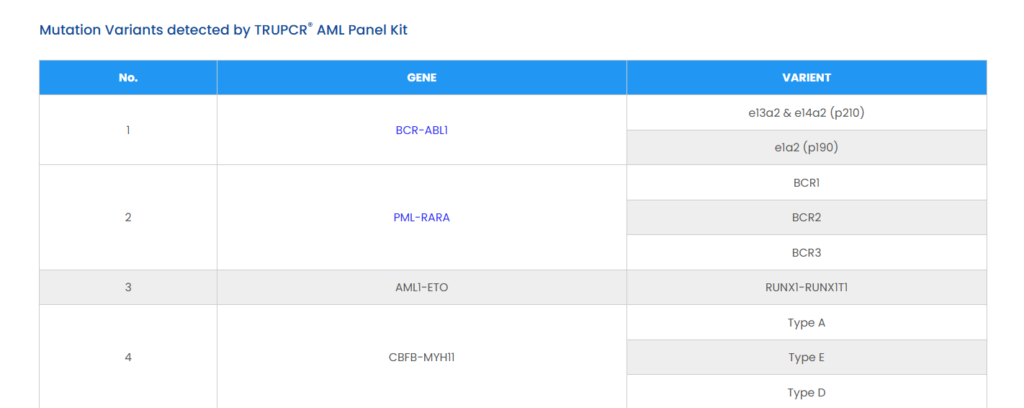
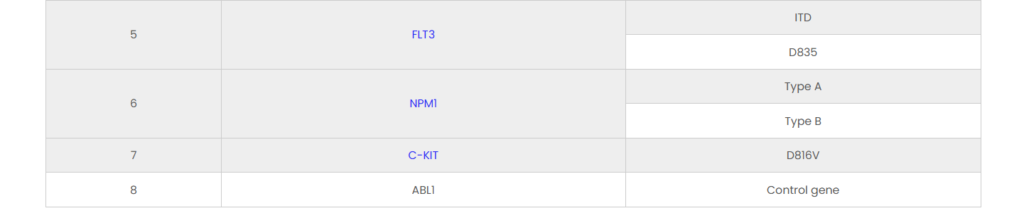
    • TRUPCR® AML Panel Kit allows comprehensive detection of most common diagnostic and prognostic markers for acute myelogenous leukaemia (AML).
    • It detects most common variants of transcripts in the fusion gene and most common mutations in prognostics markers.
    • The AML PCR test offers sensitivity to detect up to 10 copies of fusion transcripts for AML1-ETO, CBFB- MYH11, BCR-ABL1, PML-RARA and up to 1% mutant allele in background of 98% wild type allele for c-KIT, NPM1, FLT3-ITD and FLT3-D835.
    • All the reagents for cDNA chemistry, PCR and Real-time PCR are included in the kit.
    • It is compatible with various Real-time & Conventional PCR instruments.
    • Easy-to-use, rapid, reliable, comprehensive and cost-effective tests.

    AML results from clonal transformation of hematopoietic precursors through the acquisition of chromosomal rearrangements and multiple gene mutations that confer a proliferative and survival advantage and impair hematopoietic differentiation. These key oncogenic events are often classified according to the two hits model proposed by Gilliland in 2001. This model hypothesizes that AML is the consequence of a collaboration between at least two broad classes of mutations, Class I mutations that confer proliferative and survival advantages (FLT3, KIT, RAS, JAK2, CBL, PNPN11), and Class II mutations that affect the processes of cell differentiation and apoptosis (PML-RARA, RUNX1-RUNX1T1, CBFB-MYH11, CEBPA, NPM1). However, recent studies using massively parallel sequencing technologies have identified other group of mutations that do not conform to any of the two classes; therefore, they have not been classified (DNMT3a, TET2, IDH1, IDH2, WT1); however, these mainly promote epigenetic modifications. Recent evidence shows that the identification of new AML biomarkers contributes to a better understanding of the molecular basis of the disease, are significantly useful in screening, diagnosis, prognosis and monitoring of AML, as well as the possibility of predicting each individual´s response to treatment.